The operational demands on Intellectual and Developmental Disability (I/DD) providers for compliant, accurate
documentation are greater than ever. The Quality Assurance (QA) process is essential, but it is also one of
the
most time‑intensive administrative tasks agencies face. Manual review is often slow, subjective, and occurs days or weeks after services are delivered, making errors
difficult to fix. To bridge this gap, agencies are adopting Artificial Intelligence (AI) not as a
replacement,
but as a supportive tool to automate reviews, catch errors, and provide teams with the data they need to
maintain quality. Here are five ways AI can help support and improve the QA process for service providers:
Agencies generate a massive amount of data every day. For a Quality Assurance team to manually
review every single entry is an overwhelming task, especially with widespread understaffing in the
human services field. AI‑powered tools excel here. They can automatically scan your
documentation
entries, handling the volume and freeing your staff to focus on high‑priority issues.
Even the most dedicated supervisor can make a mistake. After reviewing dozens of notes, fatigue sets
in, and
it's easy to miss a required field or an inconsistency. AI doesn't get tired. An AI review tool,
like Therap
Services’s QA Assistant, can be trained to check every entry against a specific set of rules,
catching
errors or gaps that a human eye might scan over. This leads to a higher, more reliable baseline of
accuracy.
In a traditional QA process, a supervisor might find an error in a note from two weeks ago. By then,
the
staff member has to recall details from a long‑past shift, making an accurate correction
difficult.
AI makes
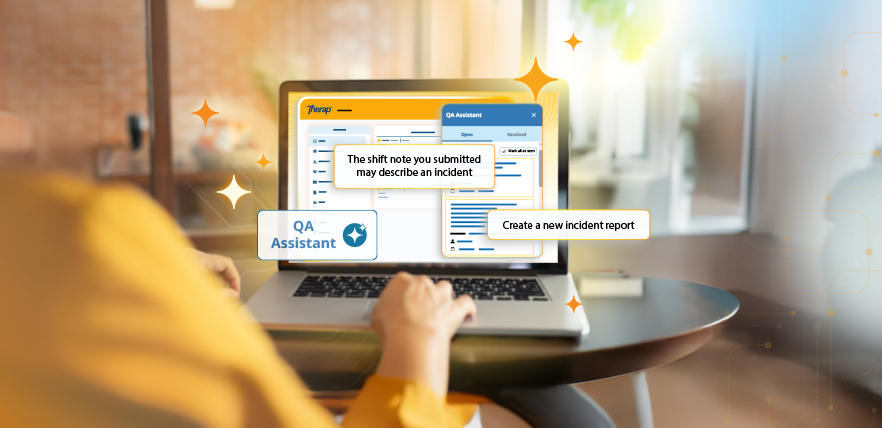
QA much more timely. An AI Assistant can flag a potential issue moments after a note is submitted,
allowing
the staff member to fix it while the information is still fresh in their mind.
This timeliness does more than just fix errors; it actively reinforces documentation best practices.
When a
staff member receives an immediate, contextual prompt—like "The shift note you submitted contains
details of
an incident. Do you want to create an incident report?"—it's a real‑time coaching moment. This
automated
feedback loop helps staff learn the standards and improves the quality of documentation moving
forward.
How does a manager really know how their team is documenting? Manual spot‑checks only provide
a
small snapshot. AI tools can aggregate review data into a centralized dashboard for supervisors. A
manager can instantly see high‑level trends, allowing them to develop an understanding of how
staff
is documenting and provide targeted support exactly where it's needed.
The potential for AI to improve quality assurance is clear. However, to truly reap these benefits, providers
need more than just a concept; they need practical tools designed specifically for the complexities and
compliance standards of the I/DD field. This is where Therap's AI
tools excel.
Therap provides a powerful dual‑approach to AI‑driven quality: ensuring data integrity at the
moment of
entry
and transforming that data into actionable insights. These tools act as a first level of defense, helping
your
team maintain quality and compliance without the administrative bottleneck.
The QA Assistant embeds support directly into the documentation workflow. Instead of waiting weeks for a
supervisor’s review, the system provides immediate feedback for Direct Support Professionals (DSPs).
High‑quality notes are only useful if they are readable. Therap’s Summarization tool quickly
transforms
mountains of daily notes, goal outcomes, and shift records into concise, high‑level reports.
Jason Laws, Therap's Director of Quality and Data Initiatives, emphasizes the immediate, practical impact of
Therap’s AI tools.
Jason Laws continues, Ready to experience the benefits of integrating AI into your team’s QA
process? Book a discovery call to learn more about Therap’s AI tools and see a personalized demo for your
agency.
5 Ways Artificial Intelligence Can
Improve Quality Assurance in I/DD Service Documentation
Benefits of AI in Quality Assurance:
It Helps Manage the Sheer Volume of Documentation
It Improves Accuracy by Catching Missed Errors or Gaps
It Ensures Timely Corrections
It Provides Real‑Time Staff Feedback and Training
It Allows for Better, Data‑Driven Oversight
Finding the Right AI Tools for Quality Assurance
Meet Therap’s QA Assistant & Summarization Tool
QA Assistant: Real‑Time Compliance
Summarization Tool: From Data to Insight
Transform Your QA Process Today
Therap Blogs
Back to Main Blog
Think about what staff members can do when we start freeing them up, rather than just
the constant repetition of documentation review.
We're looking to tailor the tools that we
have to the particular needs of providers…We want these to be practical applications that have immediate
applicability to the day‑to‑day job, saving folks time [and] improving the quality of
documentation.
