From architects designing sustainable buildings to farmers managing crop yields, people across a wide range
of industries are turning to artificial intelligence (AI) to assist them in their tasks. Service providers
in the Intellectual and Developmental Disabilities (I/DD) field are also exploring how AI can support their
work.
This exploration often begins with popular, commonly available generative AI chatbots. While these tools can
be helpful in many areas, they aren't built to meet the unique needs of I/DD service providers. In addition
to being ill-equipped to understand and assist agencies with specialized tasks, using public AI platforms
presents significant privacy and confidentiality risks. Here’s why service providers looking to implement AI
should choose options designed specifically for human services professionals:
Keeping protected health information (PHI) secure is one of the most important responsibilities of
service providers. When using AI tools, providers must be certain that the data they input will
remain secure. There is no better way to accomplish this than to use AI tools trained specifically
for human services, because they are built with HIPAA compliance and data security requirements in
mind.
From MARs to ISPs, it's no secret that the I/DD field has its own language. Generic AI tools are not
trained to understand that language, making them not only unhelpful but prone to errors. AI tools
created for human services professionals are familiar with the unique terminology and acronyms used,
allowing them to seamlessly support the work of agency staff.
General AI tools are good at performing tasks like generating text and images; however, the tasks
with which service providers are seeking help are much more specialized. AI that is created for
human services providers are trained to assist with more complex tasks, like Therap’s QA Assistant
that performs instant quality assurance checks of daily notes.
AI tools designed with service providers in mind are engineered to approach problems with the same
logic a human service professional would. They are trained to “think” in certain ways, including
focusing on person‑centered outcomes, recognizing documentation errors, and picking up on
potential
concerns about individuals, like signs of the Fatal 5.
The goal of AI tools for the I/DD field is not to replace the critical human element of support.
They assist and empower staff, reduce administrative burdens, and free up time to focus on what
matters most: supporting individuals.
Therap recognizes the immense potential of AI to help address the persistent challenges facing I/DD service
providers. Leveraging decades of experience in the human services field, we are creating tools that aren't
just technologically advanced, but practically useful.
This intelligent tool acts as a powerful first level of quality assurance, helping teams maintain quality
and compliance from the moment data is entered.
Therap's QA Assistant helps
agencies by:
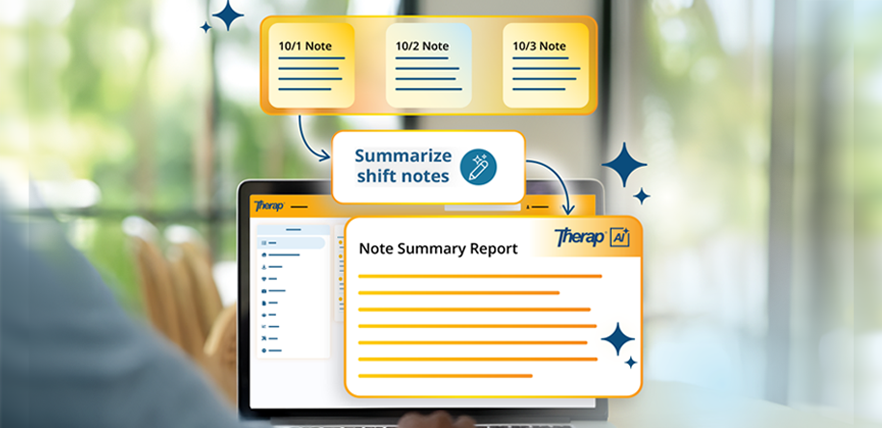
One of the heaviest administrative burdens in the I/DD field is the need to review and compile vast amounts
of documentation for ISP meetings, shift handovers, or clinical reviews. Therap’s new Summarization
tool is
designed to lighten the load for busy care teams:
Therap’s new AI
Translator promotes better understanding between staff, individuals, and families by
providing accurate translations of documentation, directly within Therap’s platform.
Ready to see how AI built for human services providers can make a
difference at your agency? Book a discovery call with Therap to learn more about our innovative AI tools.
The Right Tool for the Job:
Why I/DD Providers Need AI Built for Human Services
Built for HIPAA Compliance
Understanding of the Field's Language
Designed to Help with Documentation Tasks
Thinking Like Service Providers
Augmenting and Supporting Staff
Therap AI: Designed for Human Services Providers
Meet Therap’s AI‑Powered Toolkit
QA Assistant
AI Summarization Tool
AI Translator
Take the Next Step
Therap Blogs
Back to Main Blog
