Closing the Communication Gap:
How Electronic Documentation Unifies Your Team

Author: Margaret Gordon
|

Effective communication is vital to providing meaningful supports, but at many agencies, paper documentation stifles the connection between team members. Updates about supported individuals shouldn't be trapped in a binder, waiting for a supervisor to find them, or lost on a sticky note during a busy shift change. When teams rely on physical logs, it can create information gaps that leave staff working in isolation. Transitioning to electronic documentation bridges this gap by making it easy to share information with all of the necessary people. It ensures that critical details flow instantly between shifts, departments, and on‑the‑go staff, making your team's communication faster, transparent, and more efficient.

5 Ways Digital Tools Streamline Staff Communication
  1. 1. It helps with shift handoffs. Paper logs can be easily overlooked or misplaced during busy shift changes. A digital platform ensures that critical updates, such as behavior changes or medication adjustments, are immediately visible to incoming staff. This helps prevent information from falling through the cracks.
  2. 2. It promotes information sharing across departments. In many systems, nursing, behavioral, and support data often live in separate binders. An electronic system unifies this data, ensuring that a health issue recorded by a nurse is instantly visible to the behavioral specialist. This breaks down silos and ensures every department has access to necessary records, allowing them to make informed decisions.
  3. 3. It keeps staff connected on the go. Electronic documentation puts the power of information directly into the hands of direct support professionals, wherever they are. Instead of needing to return to a desk, staff have instant access to all the essential details right on their mobile devices. This allows for real‑time updates and collaboration without slowing down the pace of care.
  4. 4. It enables timely training opportunities. Reviewing paper binders often happens weeks after an error occurs, making feedback irrelevant. Electronic tools allow supervisors to monitor entries instantly. This shifts the focus from retroactive correction to proactive learning, turning daily documentation into a continuous learning process.
  5. 5. It accelerates response to incidents. Paper forms travel slowly, but digital systems offer instant notifications for high‑priority events. This ensures that nurses, administrators, and support teams are alerted the moment an incident occurs, allowing for immediate, coordinated action when it matters most.
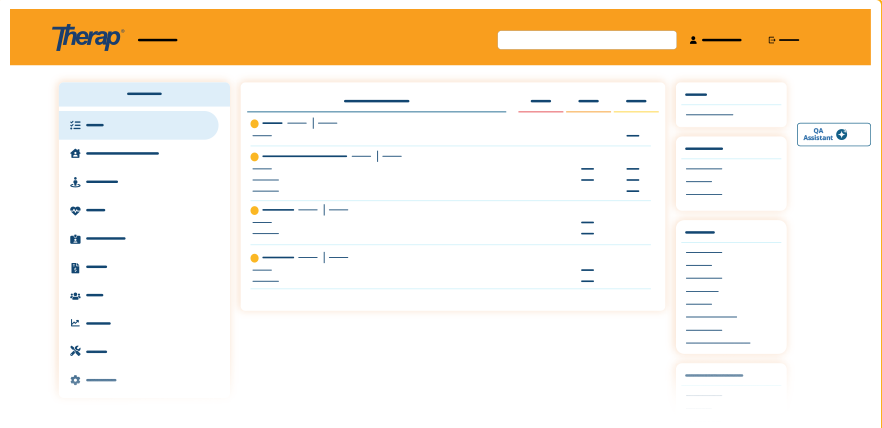
The Therap home page in stylized format

Choosing the Right Electronic Documentation System for Better Communication

To achieve better communication among your staff, you need more than just an electronic database; you need a system with tools designed to promote collaboration and data sharing, while maintaining HIPAA compliance.

Therap provides a comprehensive solution built specifically for Home and Community‑Based Services and Long‑Term Services and Supports providers. We designed our platform to do more than just store data; we designed it to connect people. By integrating powerful communication tools directly into the documentation record, Therap eliminates the disconnect between staff members, allowing your team to coordinate care effortlessly and support individuals more effectively.

Therap's Tools for Communication:

Therap's system includes dedicated modules and features designed specifically to facilitate secure, HIPAA‑compliant communication across your agency and with other authorized providers:

  • T‑log Module: The T‑log is an effective way for agencies to document and share individual‑based shift logs, progress notes, or contact and general notes efficiently. This tool allows teams to efficiently communicate day‑to‑day information, and staff members can add follow‑up details or resolve concerns in a HIPAA‑compliant way.
  • Secure Communication (SComm) Module: The SComm module is an internal, HIPAA‑compliant messaging system that facilitates the secure exchange of information among select users or teams in an agency, or between agencies regarding a service recipient. Staff can use SComm to exchange messages on agency or individual care‑related issues and can attach forms within the Therap system.
  • Signup Agreements: Therap offers a Signup Agreement feature that allows users to formally relay agency policies and essential information to users. This feature requires users to agree to a policy or statement before gaining access to or proceeding within the system. Administrators can use Signup Agreements to communicate agency‑wide information and policies.

Here's What Our Users Are Saying:

Therap completely changed the way we operate because of the ability to communicate in real‑time across programs.
Emily Maduemezia,
Assistant Director of Adult Residential Services,
Anderson Center for Autism
We use it not only as a way to document what the individual we're supporting has accomplished or how we've supported them, but we [also] use it as a way to communicate from one staff member to the next.
Russell Peterson, CEO, DreamLife Destiny

Ready to Improve Team Communication?

See for yourself how Therap can boost your team's communication and documentation efficiency!

Click here to book a demo