For agencies supporting individuals with intellectual and developmental disabilities, the definition of a
“successful outcome” has evolved. It is no longer enough for an individual to simply spend time outside of
their residence. Now, best practices in community integration focuses on people meaningfully participating
with others, building social capital, and fostering a sense of belonging.
While the goal is clear, many providers struggle to move beyond anecdotal evidence to measure progress
towards these goals. Relying mainly on daily narrative notes can make it difficult to prove that these
meaningful interactions are actually happening.
A major challenge lies in the distinction between physical presence and actual social integration. A person
might visit a local library frequently, but are they interacting with the librarian? Are they joining a
class?
Without dedicated, structured areas to capture these nuances, documentation often becomes a list of
locations rather than a record of growth. To bridge the gap between being there and belonging there,
agencies need specialized tools designed to track progress and refine person‑centered strategies.
Measuring true integration requires shifting away from basic daily logs. Instead of a simple "yes/no"
check mark for community access, providers need to focus on qualitative indicators that point toward genuine
engagement.
With the right system, agencies can target key indicators such as:
However, capturing these qualitative indicators successfully requires tracking them at the point of service.
Expecting direct support professionals to recall the specific nuances of a community outing hours later on
an office computer can lead to lost data. Mobile documentation changes the game by allowing staff to record
observations in real time, right where the integration is happening. This ensures that genuine, spontaneous
milestones, like an unprompted interaction or a breakthrough in independence, are documented accurately
before the details fade.
At Therap, we offer areas in our documentation solution that are built specifically for community
integration, helping agencies easily capture specific data points over time to identify clear patterns.
For example, if data shows an individual consistently visits a park but rarely engages with others, the team
can adjust the support plan to include more interactive opportunities.
This objective approach moves the conversation away from subjective impressions. It gives agencies the tools
they need to capture real progress, celebrate overlooked milestones, and back up person‑centered
strategies
with clear evidence.
Therap Services provides a comprehensive platform designed to turn complex community interactions into
clear, measurable data. By using the Individual Support Plan (ISP) module, Secure Video Documentation, and
Business Intelligence tools, agencies can document the journey toward full community inclusion with
precision.
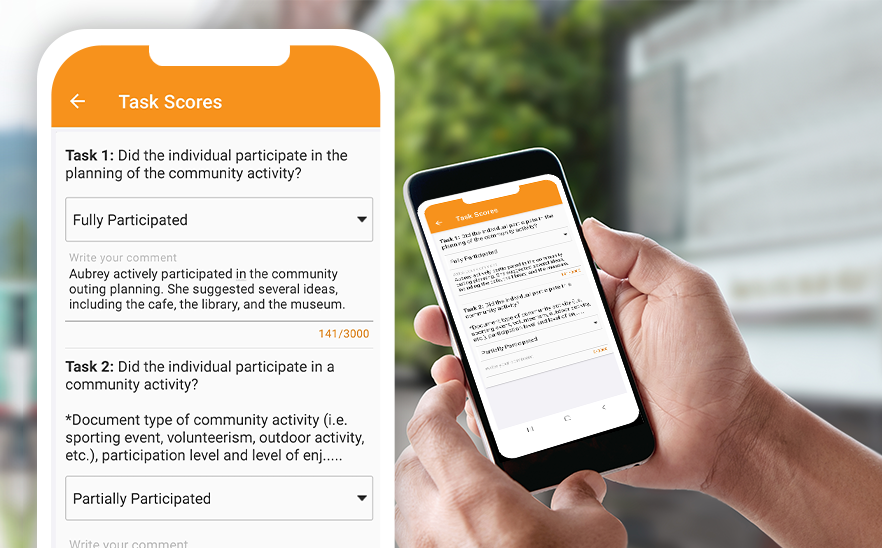
The ISP Program module in Therap allows agencies to create specific documentation templates tailored
to community goals. Instead of a generic note, staff can use task analysis and custom scoring scales
to record exactly how an individual participated in an event. For example, a program might track
whether an individual used their own money at a cafe or if they chose the destination themselves.
This level of detail provides a clear picture of the individual's autonomy and engagement levels.
While written data is vital, it sometimes struggles to capture the full picture of a social
interaction. Therap’s Secure Video Documentation allows staff to record and upload short videos of
an individual engaging in the community. This feature captures nuances that text cannot, such as a
subtle non‑verbal cue, a smile of recognition from a neighbor, or the specific way an
individual
uses adaptive equipment in a public setting. These videos serve as a powerful supplement to written
records, providing proof of meaningful participation and helping the entire support team understand
the individual's communication style.
Capturing data is only half the battle. The real value comes from being able to visualize and
analyze it at scale. Therap’s Business Intelligence (BI) platform features the Data Driven Outcomes
(DDO) dashboard, which aggregates data from ISP records into clear, graphical formats. Agencies can
use these dashboards to identify trends in community integration across an entire program or for a
specific individual. These visual tools make it easy to see if integration efforts are increasing or
if certain barriers are preventing progress, allowing leadership to make informed decisions based on
real‑time performance.
State and federal regulations, including the HCBS Settings Rule, prioritize community integration as
a core requirement. Therap helps agencies maintain compliance by providing a structured framework
where integration is a visible and documented part of the support process. The system organizes data
in a way that is easy to present during audits, demonstrating a commitment to high‑quality,
person‑centered services.
If your agency is looking for a way to better measure and promote community integration, the right
technology can make the difference. See how our data‑driven tools can help you move beyond the four
walls.
Therap provides a dedicated ISP Program module where agencies can build customized tracking sheets.
These tools allow staff to score specific tasks or behaviors related to community outings, creating a
longitudinal record of an individual's growth in independence and social engagement.
The DDO dashboard within the Therap Business Intelligence platform visualizes data collected from ISP
records. It allows administrators to see trends and outcomes in a graphical format, making it easier to
evaluate the effectiveness of community integration strategies and person‑centered plans.
Secure Video Documentation in Therap allows staff to capture real‑time moments of community
participation. This provides a dynamic layer of evidence that supports written data, helping teams see
an individual's progress in social settings and clarifying their specific support needs.
Yes, the Therap Business Intelligence platform is designed to aggregate agency‑wide data.
Administrators
can use various dashboards to identify organization‑wide patterns in service delivery, which is
helpful
for both internal quality improvement and external audits.
Therap is designed for flexibility, offering mobile‑friendly interfaces and a dedicated
Mobile App that allow staff to document community activities in real time. This reduces the
administrative burden on support professionals and helps verify that the information recorded is
accurate and timely.
Inclusion in Action:
How to Use Data to Measure Community Integration
Moving From Presence to Participation
How Therap Transforms Community Data into Actionable Insights
Structured ISP Programs for Integration
Visual Evidence with Secure Video Documentation
Data Driven Outcomes and Business Intelligence
Aligning Documentation with Regulatory Standards
Ready to Prove Your Impact?
Frequently Asked Questions: Data Analysis in Human
Services
Therap Blogs
Back to Main Blog