Artificial Intelligence (AI) is no longer a futuristic concept in human services. It is being utilized by
I/DD providers around the country right now. AI can offer effective assistance and insights to everyone from
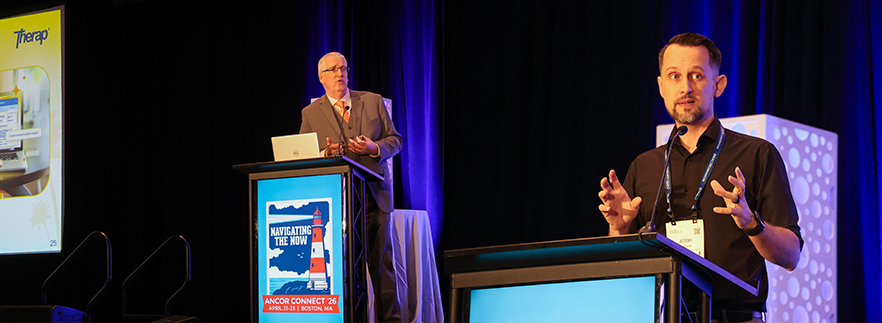
DSPs to executive leadership. This was the focus of “AI in Human Hands: Tools for More Impactful Services,”
a session at the ANCOR Connect ‘26 conference. Presenters Justin Brockie, Chief Operating Officer of Therap,
and Josh DeZurik, National Director of Quality Affirmation of Dungarvin, discussed real‑world examples
of
how AI is helping agencies streamline documentation and data analysis to improve supports.
Here are five takeaways from the session about why AI is a powerful asset for I/DD providers:
AI is allowing providers to unlock insights from narrative documentation like daily notes. While
numerical data is easy to analyze, qualitative details are often overlooked because of the time
needed to review contextual data. During the session, Josh DeZurik explained how AI is the key to
pulling helpful insights without requiring staff to spend hours scanning notes.
Modern AI reads between the lines, much like a human would. As Josh noted, AI doesn't just search
for a keyword like ‘choking’—it also flags related terms like ‘coughing’ or ‘wheezing.’ This ability
to understand context gives providers valuable qualitative insights, like whether staff are using
person‑centered language.
Because well‑trained AI understands context, it can also identify when information is missing.
In
his portion of the session, Justin Brockie talked about Therap’s QA Assistant, a “good
angel on your
shoulder” that offers in‑the‑moment feedback on documentation entries. At many agencies,
quality
assurance reviews don’t happen until days or weeks after a shift, when it is difficult for staff to
recall details accurately.
As Justin discussed, the QA Assistant scans notes as they are submitted and flags potential gaps in
seconds. For example, if a DSP writes that an individual twisted their ankle but doesn’t create an
incident report, the tool prompts them to consider additional action. While AI doesn't replace human
review, it provides a reliable first level of quality assurance that promotes better records.
Beyond giving feedback, AI can also identify documentation that needs a closer look. While QA teams
don’t have time to read every entry, AI does. Justin shared that Therap AI scans roughly 100 notes
per minute—a speed at which checking large amounts of data becomes possible.
Josh described how AI acts as a “funnel” for QA teams, narrowing thousands of notes down into the 50
that need further review. He noted, “The human is still an extremely important component.” This use
case isn’t about replacing the work of humans, but enabling them to focus their limited time where
it is needed most, ensuring critical details aren't overlooked.
AI isn’t just for quality assurance; everyone can benefit from generating summaries. Whether a
director wants key details to share with an individual’s family or a DSP needs to catch up on notes
after a vacation, AI can give them the necessary facts to stay updated.
“The ability to condense information and get to the important things is a really great resource we
can give to staff,” Justin stated. In addition to providing helpful overviews, Therap’s AI Analyses
conduct deeper analysis to highlight actionable insights, trends, and suggestions. When staff don't
have to search through records and connect the dots themselves, they have more time to support
individuals.
No two I/DD providers operate exactly alike, which is why AI's versatility is so valuable.
Organizations can create their own “toolbox” of features and use cases that fit their needs. Here
are some exciting examples Josh and Justin highlighted in their session:
As Josh and Justin’s session at ANCOR Connect ‘26 made clear, AI is already making a difference for I/DD
providers. From summarizing information to flagging subtle health risks, AI can empower agencies to utilize
more of their data while saving time to focus on what matters most: supporting individuals.
Whether you are just starting out or looking to expand your usage, the best way to unlock the benefits of AI
is to use it actively. Justin advised, “You have to engage with AI to understand what it does in your
organization.” Josh DeZurik agreed, emphasizing that “AI literacy is a skill. You have to use it. You have
to practice it.” With so many practical ways AI can assist providers, now is the perfect time to learn how
to harness its power.
AI in Human Hands:
Five Ways AI Can Help I/DD Providers

Unlocking Insights from Written Records
Giving Staff Real‑Time Feedback on Entries
Identifying Priorities for Quality Assurance
Condensing Data into Useful Summaries
Offering a Growing Toolbox
Why Providers Should Start Using AI Today
Want to learn more about Therap AI and the tools mentioned
in this blog?
Book a demo
Therap Blogs
Back to Main Blog