Lutheran Social Service (LSS) of Minnesota provides a variety of disability services to individuals
throughout the state. With programs spread so widely, the agency faced the challenge of varying
documentation and communication methods from one location to another. This changed in 2011 when they began
using Therap’s electronic documentation system to consolidate information into a centralized hub and create
more consistency in supports across their entire organization.
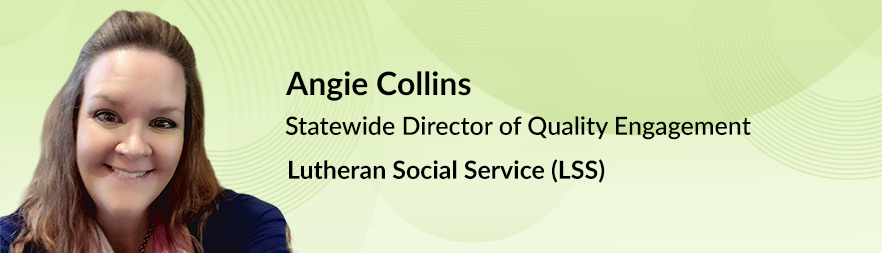
Angie Collins, the Statewide Director of Quality Engagement at LSS of Minnesota, has witnessed the benefits
of Therap firsthand since its initial implementation. Having spent nearly 30 years in the industry, Collins
has watched the evolution of documentation, from the paper era to the modern efficiency of electronic
systems. For Collins and her team, Therap isn’t just a software platform; it is the bridge that connects
their statewide programs, streamlines daily tasks for staff, and empowers the agency to make informed,
data‑driven decisions at every level.
A common challenge for large agencies is maintaining continuity of care during staff transitions or
absences. By having all of their documentation within Therap, LSS of Minnesota ensures that staff have
access to the information they need to provide informed and consistent supports. “Throughout the years,
one of the biggest benefits has been having all the information in one place when there are vacancies,
illnesses, [or] changing of personnel. We can fill in and have everything at our fingertips... that just
really helps ensure the safety of the people we support,” says Collins. This access also allows staff to
provide more person‑centered supports when filling in. “I can read up on what makes [individuals]
happy,
content, satisfied, fulfilled, comforted before I get there,” she says.
Another significant advantage of Therap has been its ease of use for critical daily tasks, such as
documenting medication administrations. When LSS of Minnesota switched to using Therap’s Daily MAR, Collins
was worried about how staff would handle the transition. “Trying to get 1,200 people excited about change is
hard. They adapted to it very quickly and so that is a big success,” she says. Staff not only embraced the
change, they were excited about it. Collins shares, “I assisted a very long‑term employee in
configuring a
MAR for Warfarin. Daily MAR made it way easier. She was cheering and telling everybody that it worked!” For
Collins, moments like this are powerful. “The best part of using Therap is watching the light bulb moments
for people,” she says.
In addition to helping staff complete daily tasks, Therap empowers LSS of Minnesota to look at the big
picture. Collins uses Therap’s Business Intelligence tools and Report Library to access data and reports to
gain a better understanding of organizational performance and help drive decisions. “I'm excited to get
everything at a click of a button and be able to provide those successes and challenges in data form to the
organization leaders, the cabinet, and the board,” she says. Collins emphasizes, “When things are simple, we
get good data. Good data leads to understanding where our successes are [and] where our challenges may lie.
In my opinion you can't really argue with data.”
Join the 15,000+ providers who trust Therap Services to streamline their documentation and support
their missions.
Standardizing Success:
How Lutheran Social Service of Minnesota Unified Statewide Documentation with
Therap
Documentation Where It’s Needed, When It’s Needed
Ease of Use and “Light Bulb Moments”
The Power of Data
Are you ready to bring consistency, safety, and
data‑driven
success to your organization?
Therap Blogs
Back to Main Blog
I assisted a very long‑term employee in configuring a MAR for Warfarin. Daily MAR made it
way
easier. She was cheering and telling everybody that it worked! The best part of using Therap is
watching the light bulb moments for people.
I'm excited to get everything at a click of a button and be able to provide those successes and
challenges in data form to the organization leaders, the cabinet, and the board.