AI is evolving quickly, bringing both new opportunities and complex questions to the human services field.
Organizations are navigating decisions around selecting the right tools, maintaining data privacy, and
creating policies for staff.
To share guidance with organizations considering or starting to use AI, Therap Services hosted a virtual
panel, AI in Action: How AI is Shaping Service Provision. In this session, four of Therap’s
industry experts shared helpful updates and tips providers should know.
Here are seven takeaways from the session:
Many I/DD Providers are still undecided on utilizing AI. Jason Laws, Therap’s Director of Quality
and Data Initiatives, shared this thought on why agencies should consider exploring new technology:
"Human service providers owe it, certainly to all of the stakeholders within the industry, but
most importantly, to the people they serve, to do the absolute best job possible in the
provision of supports and services. And that means taking advantage of the best tools available.
AI certainly fits that bill."
If your agency hasn't adopted AI yet, don't worry. Director of AI Strategy Will Sepesi shared,
"You're not behind if you haven't started yet. It's a great time to get on this wave and start
figuring out how you can use it to provide better services and better care."
A growing number of organizations are starting to leverage AI, especially as more tools built
specifically for the human services field are released. Solutions like
Therap AI now offer
the practical assistance and strict data security that agencies need. During the session, the
panelists emphasized that adopting AI does not need to be overwhelming. Instead, they recommend
starting small: find a few tasks at your agency where AI can help, and try out a secure tool to see
how it works for your team.
Karen Niedermeier, Associate Director of Business Development at Therap, warned that even if your
agency hasn't officially rolled out AI yet, staff members might already be using these tools on
their own. "Your staff are likely already using AI. The important piece is to be educating them on
making sure that it's not compromising information and that it's not risking HIPAA issues," she
said. Providing clear guidelines, policies, and training can empower staff to use AI responsibly.
AI is great at interpreting large amounts of data. This is especially valuable to I/DD Providers,
who collect data constantly through daily documentation. AI can analyze that data to deliver
impactful summaries, reports, and insights; however, it relies entirely on the quality of
information given.
Fayonne Johnson, Therap’s Associate Director of Support, reminded attendees that AI is not a
replacement for staff entering detailed documentation:
"A big misconception for a lot of people is that AI is this magic wand that's going to solve their
problems, or do their documentation better, and that's not the case at all. If anything, AI is a
gigantic mirror; it's going to reflect, and in some cases, amplify what you have in your system. It
can't summarize or analyze if the information is absent or incomplete," she said.
Jason Laws, Therap's Director of Quality and Data Initiatives, echoed this sentiment, noting that
"the most powerful tool in the world can't do much if the data that's getting fed into it is either
inaccurate or sparse." By prioritizing thorough daily documentation, your team builds the strong
data foundation required for AI to offer meaningful assistance.
Many people are afraid that AI will replace human jobs. The panelists provided some reassurance.
Niedermeier stated that the expertise and judgement of human services professionals is
irreplaceable, even when using AI:
"You are still the experts. What AI is doing is helping you have all of the tools you need to
make better decisions about the care that you're providing. It's not making decisions for you.
It's not replacing your professional, human judgment," she said.
More I/DD Providers are using AI than ever before, and even state and federal agencies like CMS are
also adopting it for auditing purposes. As a result of this rapid growth, new regulations and
policies are being established across the country. Niedermeier pointed out that the number of states
with active AI policies jumped from 2 to 46 in the last few years. While she recommended looking
into your state’s guidelines, she emphasized one core fact that all providers need to understand:
"AI documentation equals provider documentation. [Auditors] don't really see a difference. You hit
submit...that becomes your documentation," she said.
Niedermeier stressed that this fact shouldn’t scare people away from adopting AI, but encourage
everyone to maintain proper oversight and governance. Every AI‑generated summary or report
should be
reviewed before it is submitted to confirm that the documentation is accurate and aligned with state
and federal regulations.
For leadership at I/DD organizations, choosing an AI platform can be a tough decision. The panelists
recommended considering options that offer HIPAA‑compliant data security and are able to
understand
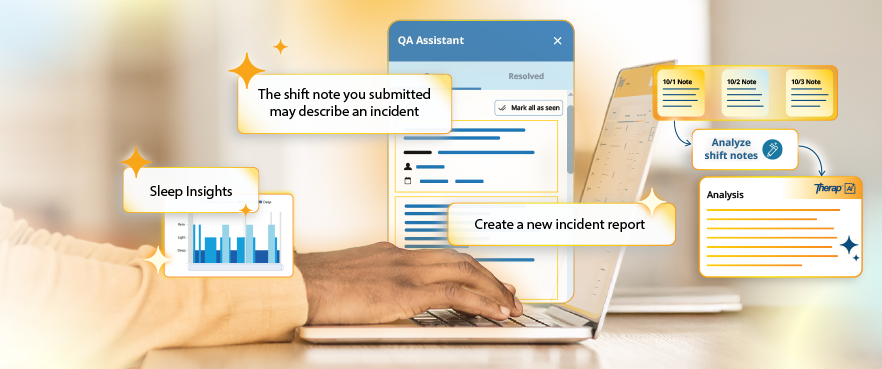
and assist with tasks specific to the I/DD field. They discussed why Therap AI is a great option and
shared some of its latest features:
Johnson spoke about the benefits of having a technology partner like Therap that understands the
human services field and can help I/DD Providers navigate AI use amid the shifting landscape and
regulations:
"AI is moving rapidly. There's a lot changing, and Therap wants to tap into all of the decades of
experience and relationships the company has built. With over 20 state and local government
contracts, Therap looks at how it's done around the country to build a responsible system with best
practices and data security in mind. Tools are being built to solve problems for things our team
members lived through themselves," she said.
To wrap up the session, the panelists shared some practical next steps for human services professionals
exploring AI:
To learn more about Therap’s suite of AI tools for I/DD Providers, visit our
AI Page
or
AI in Action: 7 Insights
for I/DD Providers Navigating AI Implementation

1. Keep an Open Mind to Using New Tools.
2. You Aren’t “Behind," You’re Right on Time.

3. Your Staff Are Likely Already Using AI.
4. AI Needs Good Data in Order to Assist You.
5. Human Expertise Remains Essential.
6. You Are Responsible for Documentation Created with AI.
7. Choose Reliable Tools That Fit Your Agency’s Needs.
Ready to Get Started?
Therap Blogs
Back to Main Blog