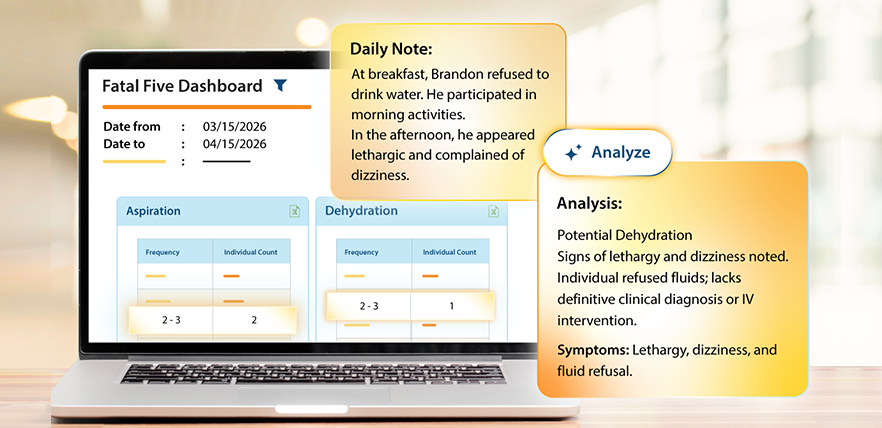
For agencies supporting individuals with intellectual and developmental disabilities (IDD), effective incident management is crucial. Identifying risks, recording events, and tracking outcomes are critical steps in protecting the health and safety of the people you support. However, traditional incident reporting can be time‑consuming and error‑prone. Staff members frequently face mountains of paperwork or disjointed files, making it difficult to spot subtle trends or catch missing details before they become significant issues. This is where artificial intelligence is beginning to offer impactful assistance. AI is changing incident management by shifting the focus from reactive record‑keeping to proactive risk prevention. Historically, tracking incidents required managers to manually review numerous reports to find common threads or missing information. A minor behavioral event or a seemingly isolated health symptom could easily slip through the cracks. Now, modern AI tools act as a second set of eyes. By leveraging pattern recognition, AI can quickly analyze data across an organization to highlight anomalies, flag incomplete documentation, and provide a deeper understanding of the factors leading up to an event. Instead of waiting for an incident to occur and then reviewing the paperwork, agencies can use AI to detect warning signs early. This reduces the likelihood of missing critical information and helps teams make data‑driven decisions that improve individual care. Using AI to assist with incident management requires reliable tools designed specifically for the human services field. Therap Services offers a comprehensive documentation system equipped with a suite of purpose‑built AI features to help teams with a variety of tasks. Here are the features created to assist with tracking incidents and gaining meaningful insights from entered data: Reviewing incident reports and shift notes for accuracy is a time‑consuming task for quality assurance teams. Therap’s QA Assistant utilizes intelligent pattern recognition to flag missing elements or anomalies in documentation. This helps verify that incident reports are complete, accurate, and submitted without delay. By reducing the manual burden of document review, the QA Assistant frees up supervisors to focus on actionable resolutions rather than searching for missing data. It acts as a safeguard, catching incomplete reports before they impact compliance or individual safety. For individuals with IDD, certain preventable health conditions pose significant risks. Therap’s Fatal Five Dashboard is an AI‑powered tool designed to monitor these critical areas. The dashboard scans daily notes to surface patterns related to the “Fatal Five” conditions: aspiration, dehydration, seizures, constipation, and sepsis, as well as GERD. By detecting and displaying these risk indicators in a single organized view, the dashboard allows teams to gain a clearer picture from the data. Staff can identify subtle changes in a person’s baseline health and intervene promptly to prevent a medical event from escalating into a critical situation. Ready to see how artificial intelligence can streamline your incident management and enhance the quality of your services? Contact the Therap team today to explore our advanced AI tools and configurable documentation platform. Therap provides a General Event Reports (GER) module that allows staff to log injuries, behavioral events, and medication errors directly from the point of care. This creates a clear, structured record for quality assurance teams to review. Yes. Therap features a QA Assistant that uses intelligent pattern recognition to review shift notes and incident reports. This tool spots potential issues that require a closer look, helping agencies maintain high standards of accuracy and compliance. The Fatal Five Dashboard is an AI‑driven tool within Therap that scans daily notes to identify risk indicators for aspiration, dehydration, seizures, constipation, sepsis, and GERD. It consolidates this information to help staff monitor critical health patterns proactively. Therap is a HIPAA‑compliant platform with strict role‑based permissions. This restricts access to sensitive reports, keeping PHI secure while allowing authorized personnel to perform necessary oversight. How AI Is Changing Incident Management in IDD Services
The Evolution of Incident Management
Therap’s Approach to AI‑Powered Oversight
QA Assistant
Fatal Five Dashboard
Ready to Get Started?
Frequently Asked Questions
How does Therap help agencies track reportable incidents?
Can AI assist with documentation compliance?
What is the Fatal Five Dashboard in Therap?
Will Therap keep our incident data secure?

