Managing documentation within agencies that support individuals with intellectual and developmental
disabilities (IDD) requires balance. Direct support professionals (DSPs) and administrative staff must
manage significant volumes of critical information daily, ranging from Individual Support Plan (ISP)
outcomes and daily notes to incident tracking and medication administration. Relying on paper binders or
generic electronic health record (EHR) platforms often creates operational bottlenecks and increases
compliance risks.
Specialized IDD documentation software addresses these challenges directly by providing digital systems
built specifically for the workflows of human service providers.
IDD documentation software is a specialized digital platform designed to capture, organize, and track
services provided to individuals with intellectual and developmental disabilities. Unlike standard medical
EHRs used to track occasional clinical visits, IDD systems focus on person‑centered, long‑term
support.
These platforms digitize routine administrative and operational tasks, offering specialized tools for:
At its core, IDD documentation software replaces fragmented paper files with a centralized,
cloud‑based
data repository accessible from desktop and mobile devices.
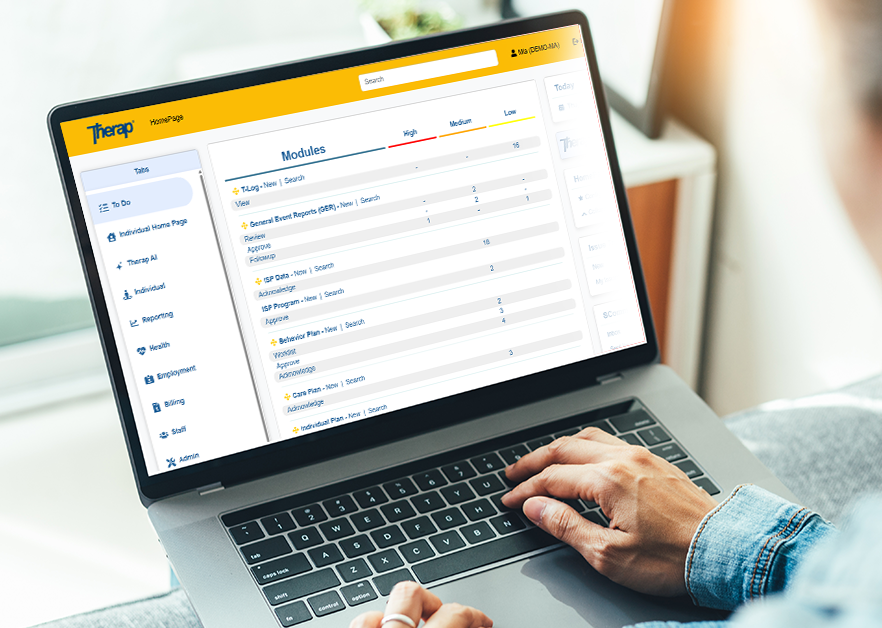
Therap Services delivers a purpose‑built documentation platform tailored explicitly to the needs of
human
service providers. Therap equips over 15,000 human services agencies across the U.S. with intuitive tools
that simplify record‑keeping and optimize team communication.
No two service providers operate identically. Therap provides configurable software components, including
adaptable dashboards, specialized form builders, and customizable approval workflows. Agencies tailor the
platform to fit their needs without requiring custom software development.
Therap connects every tier of an agency within a single interface:
Therap provides a variety of tools that empower person‑centered planning and supports By utilizing
resources
like the Personal Focus Worksheet and Charting the LifeCourse frameworks, agencies can build deeply
personalized plans based on what matters most to each person. In addition, Therap’s Secure Video
Documentation feature allows individuals to actively participate in their documentation by recording "About
Me" Videos to introduce themselves and share what matters to them with staff.
Transitioning to a dedicated digital platform simplifies administrative tasks, strengthens compliance, and
gives your staff more time to focus on delivering quality support. Book a Demo with Therap today to explore
how our configurable documentation system can support your agency.
Standard healthcare systems focus primarily on clinical diagnoses, physician visits, and acute medical
billing. Specialized IDD documentation software like Therap focuses on long‑term habilitation
goals,
daily support logging, person‑centered plan tracking, and state human services compliance.
Therap provides mobile‑friendly applications that allow direct support professionals to log shift
notes,
review support plans, and record goal progress directly from mobile devices. This reduces
shift‑end
paperwork and keeps information up to date.
Yes. Therap features configurable form options, customizable reporting tools, and flexible workflows
designed to help agencies adapt their documentation practices to specific state regulations and
organizational standards.
Digital documentation systems restrict access to sensitive personal data through role‑based
permissions
and encrypted data storage. Therap maintains compliance with HIPAA security rules to help protect
confidential medical and demographic information across the entire agency.
IDD Documentation Software: What It Is and How It Works
What Is IDD Documentation Software?
How IDD Documentation Software Works
Therap Services: A Complete Solution for IDD Service Providers
Flexible and Configurable System
Comprehensive Service Documentation
Person‑Centered Tools
Streamline Your Agency Documentation Today
Frequently Asked Questions
Therap Blogs
Back to Main Blog